Pages

Monday, November 21, 2011

Our 2012 Calendar - The Inside Story

Our creative efforts here at CR Print are often collaborative endeavors that emerge from several people kicking around an idea. I hesitate to call that "brain storming" because it doesn't feel all that deliberate or planned. Take our 2012 calendar for example. You can get one of these free, by the way, by going to the CR Print website and clicking on "Free Calendar." 

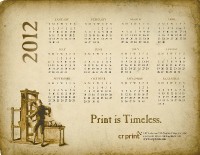
We design a new, single page, calendar every year. Our clients like the full year at a glance and the handy size for their desk top or wall. Generally, we try to create a different theme for each year and/or tie the design of the calendar into the design of our brochure or other marketing materials. This year we used an environmental look for our brochure that featured a sunrise, blue skies and a field of flowers. We planned on using the same theme for our 2012 calendar, but none of the designs we came up with met with any enthusiasm from our marketing team. Earlier, Mike had made a suggestion that we try a "vintage" press room look for our Holiday card using cross hatch illustrations. The card had a lot of possibilities and was fun to develop. Why not do the same thing for the calendar? Besides, this  theme is evocative of the role of printing in the American Revolution, a history in which our industry takes some pride. 

But this would be a major departure from past designs. The calendar was always a colorful piece that people liked to put up on their wall. A vintage style calendar would lack color and look, well, old. Would it work? And what message could we put on the calendar? Last year's calendar carried the message that "Print Keeps Things Personal."  We wanted to convey some of the subtle advantages of a printed message over an e-message. How could the "vintage" look do that? Mike provided the answer. "Print is not just more personal," he said, "print is timeless."

That was the clincher. We determined to make the calendar look like an old, historic, document that has survived the ages. We chose a font called Caslon Antique that has a slightly distressed look. We used Sundance Felt cover stock (the color is called "natural white") to provide texture and printed an aged, or distressed, background image behind the calendar and on the reverse side. Although it appears brown, it is actually printed in process color. The combination of yellow, red and a touch of blue ink, printed over the yellowish Sundance stock gives it that vintage look.

One thing we did not count on was how it might look as an online image. Seen online, it looks like an old document that has been scanned. It is not all that interesting or inviting online. Something of the "Timeless" theme is lost when you are not actually holding a document in your hands. Maybe that is as it should be. People who pick up the calendar invariably get a smile on their face. They turn it over to look at the back side. They are holding a year 2012 calendar that looks like it was printed two hundred years ago. That is what we were trying to achieve - an illustration of the power of print.

Wednesday, November 2, 2011

Should Your Message be Cast in Stone, or Should You Just Go Bananas?

One of the more interesting environmental innovations for the printing industry is the development of paper made from stone.The idea is to replace paper made from wood pulp (read "trees") and reduce the water and energy required to produce the paper. Stone papers are generally made up of crushed limestone bound into sheet form with a non-toxic polymer resin. Manufacturers boast that paper made from stone requires no water and no bleach, is biodegradable, and uses significantly less energy to make than paper made from traditional fibers - even recycled fibers. Others argue that mining is destructive and minerals, unlike trees, are a non-renewable resource. For a discussion of the environmental issues, go to TreeHugger Forum.

There are a number of these stone based papers on the market. Brands include Paperocks, Fiberstone, TerraSkin, Viastone, Rockstock, Stonepaper, and probably a few others I have not run across yet. We have used the Paperocks brand here at CR Print, but none of the others. In terms of print production, paper made from stone has very high ink hold-out properties. That is, the ink stays on the surface and does not absorb readily into the paper. This can provide a very nice looking print job, as it does for most coated papers. But with the stone paper, it also results in extended drying time. We are talking days rather than hours here. It is best to avoid heavy solids if your design is intended for stone papers. The stone papers are also heavier and somewhat slower to run through a press. Don't get me wrong, stone papers have a wonderful, unique feel and are terrific for those special, high touch, projects. Just allow some extra production time.


There are lots of other non-tree-fiber papers available in today's market. There are synthetics like Polyart and Yupo, which have the advantages of being water, grease, and tear resistant. There are also papers made from alternative plant fibers like kenaf or hemp, even bananas and mangoes. Here at CR Print, we have printed on a number of non-tree-fiber papers, including the synthetics mentioned above and paper made from kenaf, bananas, and coffee.  If you have a special project for one of these products, give us a call. We can help in the planning stages so you make the most of these unique papers.

Monday, September 19, 2011

Every Door Direct Mail

The USPS launched its Every Door Direct Mail program, EDDM, with the idea of making direct mail easier and more accessible to small businesses. It is a good idea. Acquiring mailing lists and postal permits and meeting all of the requirements of the USPS for bulk mail can be more of a burden than many small businesses can handle. With EDDM you can do a mailing without applying individual names and addresses to each mailing piece. You can target a city or pinpoint a specific neighborhood.

EDDM is especially beneficial to small retail stores that rely on traffic within their own neighborhood for a good part of their business. Pizza places, dry cleaners, convenience stores, small restaurants, deli's, auto mechanics, maintenance services, beauty salons, and similar businesses can all benefit from direct mail advertising at a lower cost. Even businesses with generally larger geographic markets, like auto dealers, roofers, or heating and air conditioning providers can increase their market share in a specific neighborhood through EDDM.

Of course, there are some requirements. You have to mail at least 200 pieces, but fewer than 5000. They must be standard flats and weigh less than 3.3oz each. You can plan your mailing yourself using the tools provided online by the USPS. Or you can use a mail service provider, like CR Print, to plan, prepare and deliver your mailing piece to the post office. Either way, you save the cost of buying a mailing list, a permit, and individually addressing each piece.

Tuesday, August 16, 2011

Our Story

It has become a marketing commonplace today for businesses to tell their own unique “story,” or tales of how the business got started. The eureka moment when a new idea struck, or the grandparents brought the first seedlings from the old country, and similar histories, are all ways of helping to “brand” the company in the eyes of the consumer. These intriguing and often heart warming tales tell of the founding of the company and the dedication and sacrifice that brought it to where it is today. It is great stuff, and indispensable to many marketing programs.

We don’t have that kind of story. We are not descendants of Gutenberg, Ben Franklin or even R.R. Donnelly. We didn’t invent the technology or even a new way to use it. And we aren’t going to invent a heart warming tale to instill our brand into your memory.

We started in a small storefront in 1983 and learned very quickly that people bought printing because they had something important to communicate. Our job was to help them achieve their communication goals. We knew instinctively that if they succeeded in their communications, then we would be successful as well. We worked hard and took every opportunity to improve our skills.

Hard work pays off. Today, we are much bigger then we were in 1983, and the communications technology we use has expanded immeasurably. But some things have not changed. Our clients still have important things to communicate and our job is still helping them to succeed by providing the communications vehicles that help them to achieve their goals.

That’s our story.